chit at work
A Bee AI alternative
Bee is an always-listening wearable, acquired by Amazon in 2025. chit is a card that records only while you hold a button. Both are trying to solve the same problem — the conversation you will want later and did not write down — and they answer it with opposite design decisions. This page is about that difference, not about whether one of them is bad.
Two designs, plainly
A continuously listening wearable is on and capturing while you wear it. You do not decide what matters in the moment; you sort it out afterwards. That solves the biggest real failure in note-taking, which is that people do not know in advance which sentence they will need.
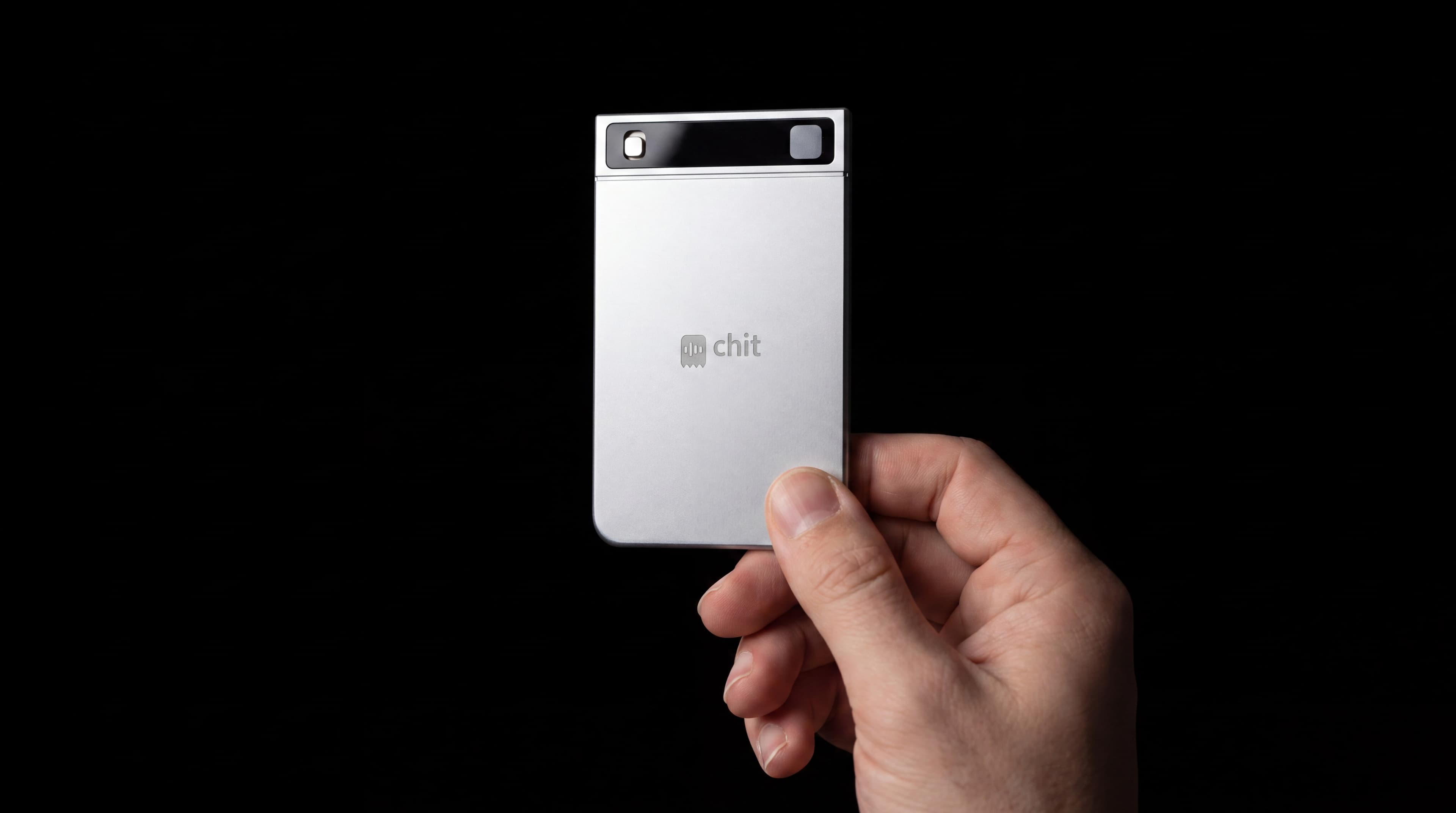
chit does the opposite. It has no wake word and no always-on microphone, and the firmware captures only while the button is physically held. You decide, in the moment, that this is worth keeping. That means you will miss things a wearable would have caught.
Neither of those is a trick. They are two positions on one trade, and which is right depends on what you do for a living and who you are around all day.
Where the difference actually bites
It is not a privacy-in-the-abstract question, it is a room question. If you spend your day in conversations with people who are not your colleagues — clients, patients' families, candidates, counterparties, other people's employees — an always-on device puts you in the position of being the person in the room whose device may have been recording the whole time. Some people are entirely comfortable with that and disclose it. Others are in professions where it is a non-starter.
A held device removes the question rather than answering it. Everyone can see when it starts and when it stops, because it stops when you let go.
The legal part, carefully
Recording law in the US varies by state. Most states permit a recording where one party consents; roughly a dozen require every party to agree. Those rules apply to the recording, not to any particular product, and both of these devices can be used lawfully or unlawfully depending on what you do with them.
Nothing on this page says that Bee, or any always-on device, is unlawful — that is not the case and it is not our claim. And nothing here says chit makes a recording lawful; it does not. What a hold-to-record design does is make the fact of recording visible and bounded, which is a practical property rather than a legal one. If this matters for your work, ask a lawyer in your state, not a product page.
What chit gives you
Every capture becomes a transcript with the $9 a month membership, the day comes back as a digest of what happened and what was decided, and ask-anything search runs across everything you have captured. The device is $129 for chit one or $179 for the Pro, records offline, and runs about a month of typical use on a charge.
Good questions
Is chit always listening?
No. There is no wake word and no always-on microphone — it captures only while the button is physically held.
Is an always-on wearable illegal?
No. Recording law varies by state and applies to what you record, not to a category of device. Nothing here says otherwise, and none of this is legal advice.
Does chit make my recordings legal?
No, and we would not claim that. It makes recording visible and bounded, which is a design property. Whether a particular recording is lawful depends on your state and your situation.
What do I lose by not having it always on?
The sentence you did not know was important. That is the real trade, and it is the reason continuous wearables exist — worth being honest about before you buy either one.
Reviewed 2026-08-07.
Nearby trades