chit at work
Dictaphone vs an AI voice recorder
If you already own a Sony or an Olympus or a Philips and it works, this page is not trying to talk you out of it. Dedicated dictation hardware is very good at the thing it does, and the case for something else is narrower than most comparison pages admit.
What a dictaphone is genuinely better at
Microphones. A purpose-built dictation recorder has a bigger, better-positioned microphone than anything the size of a credit card, and for long-form dictation into a quiet room that difference is real.
Runtime and storage. Many will record for tens of hours on a charge and hold hundreds of them, with no service behind it and nothing to subscribe to.
No account, no cloud, no fee. For air-gapped work, for anyone whose IT policy forbids audio leaving the building, or for someone who simply does not want another subscription, that is not a limitation — it is the requirement, and it is one a connected device does not meet.
If those describe you, buy the dictaphone. It is the right tool.
What it does not solve
A dictaphone produces audio. That was the whole job when the other end was a transcriptionist, and it is why the category was built the way it was.
What it does not do is make the audio findable. Four hundred files with sequential names is an archive only in the sense that everything is technically in there. Nobody goes back through it, which means the value of every recording collapses to whatever you did with it in the first week.
The second gap is what happens after. A recording is not a note. What you usually wanted was the three decisions, the two commitments and the date — and getting from audio to that is either your evening or somebody's invoice.
What the other category does
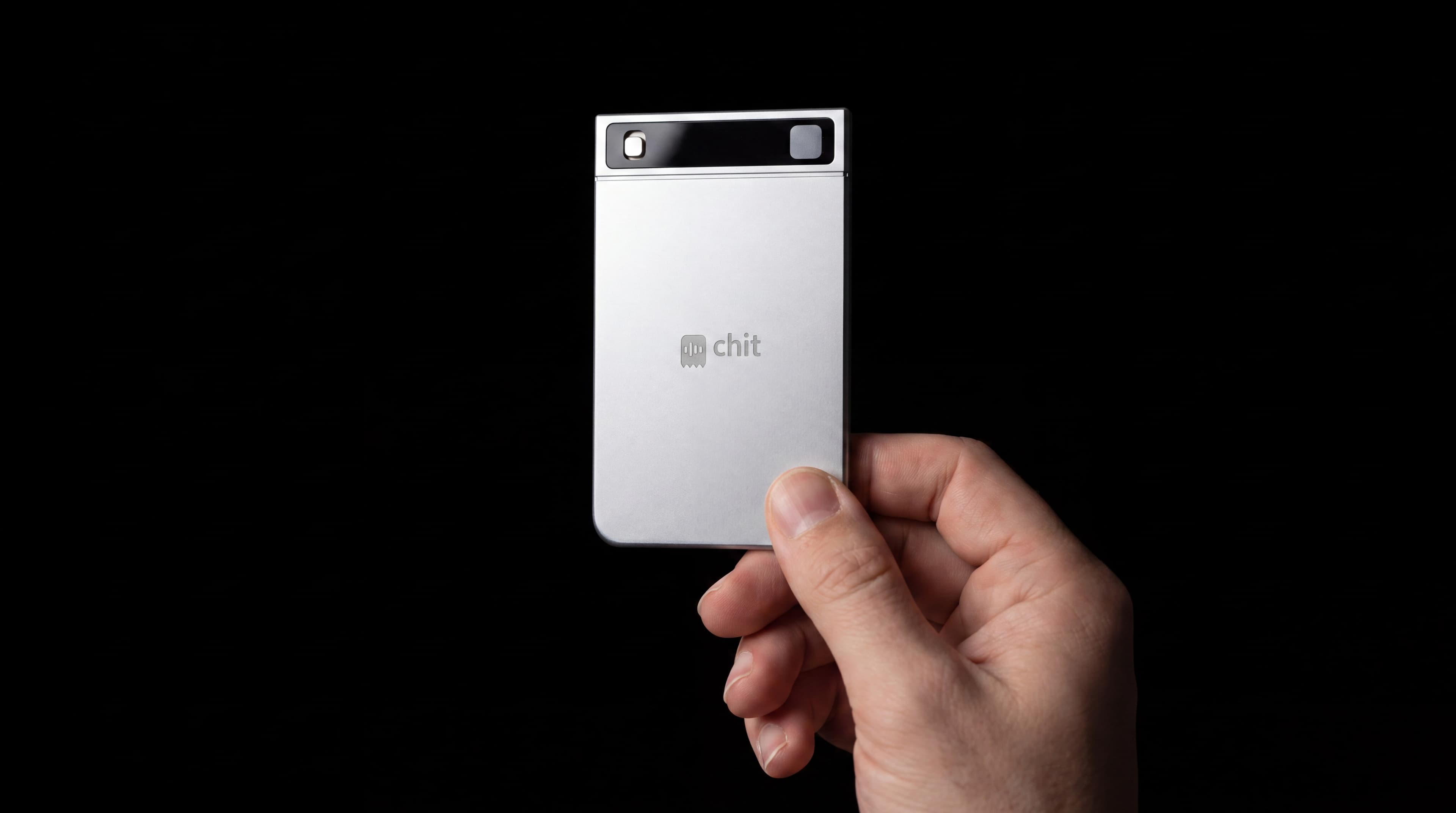
chit is a card with one button. Hold, speak, release. With the $9 a month membership every capture becomes a transcript, the day comes back as a digest of what happened and what was decided, and ask-anything search runs across everything you have ever captured — which is the part a dictaphone structurally cannot do, because it has no idea what is in its own files.
It is also smaller than any dictaphone, at 3.9 millimetres, and runs about a month on a charge. It records offline and syncs afterwards, so the connection is not needed at the moment that matters.
Choosing between them
The question is not which device is better. It is which half of the problem you have.
| If you need | Choose |
|---|---|
| The best possible audio of a long dictation | A dictation recorder |
| No cloud, no account, no subscription | A dictation recorder |
| Hours of continuous unattended recording | A dictation recorder |
| To find what was said months later | An AI voice recorder |
| Decisions and next steps, not audio | An AI voice recorder |
| Something that fits in a card slot | An AI voice recorder |
Good questions
Is chit a dictaphone?
No. It is built for short deliberate captures — a recap, a finding, a decision — rather than long continuous dictation. A dictation recorder has a better microphone and far longer runtime for that job.
Can I use it for letter dictation?
You can, and the transcript comes back. But if dictation is the main job, dedicated hardware with a better microphone and no subscription is the more sensible buy.
Does it need the internet like a dictaphone does not?
Recording does not — capture works with no connection. The transcript and the digest arrive after the device next syncs, which is the honest trade for what it does with the audio.
What if my firm will not allow cloud storage?
Then a standalone recorder may be the right answer. The other option is an enterprise deployment where the data is resident in your own VPC rather than ours — see hichit.com/enterprise.
Reviewed 2026-08-07.
Nearby trades