chit at work
How to record audio in a noisy environment
Search this and you get advice about acoustic treatment and microphone polar patterns, written for people recording podcasts. None of it helps if you are standing next to a compressor and need the model number to come out right. This is the version for speech you intend to have transcribed.
Distance beats everything else
Sound falls off with distance fast, and that works in your favour: halving the distance between your mouth and the microphone does far more for intelligibility than anything you can do about the noise itself. If you take one thing from this page, it is that moving the recorder closer to your mouth is worth more than every other technique combined.
The practical version is arm's length or closer — the distance you would hold something you were reading. Most bad field recordings are not bad because the site was loud; they are bad because the recorder was on a bench four feet away.
Put your body between the noise and the microphone
Turn so the loud thing is behind you. Your torso is a surprisingly effective barrier, and the difference between facing a running compressor and having your back to it is large and free.
Cupping a hand around the microphone side helps for the same reason — it shields one direction. Outdoors, that hand is also what stops wind, which is worse for transcription than machinery because it saturates rather than competes.
Change what you say, not just how you record
This is the part nobody writes about, and it matters more than the acoustics.
- Say numbers twice. "Eighteen four hundred — one eight four zero zero." Model numbers, prices and dates are exactly what transcription gets wrong and exactly what you needed.
- Spell proper nouns once. Names of people, streets and manufacturers have no context to be recovered from.
- Short sentences with pauses. Continuous speech in noise degrades much faster than deliberate phrases with gaps.
- Say the units. "Forty amps" survives a bad recording in a way that "forty" does not.
- Step away first if you can. Ten feet and a corner is often available and is worth more than any technique here.
What the device shape does
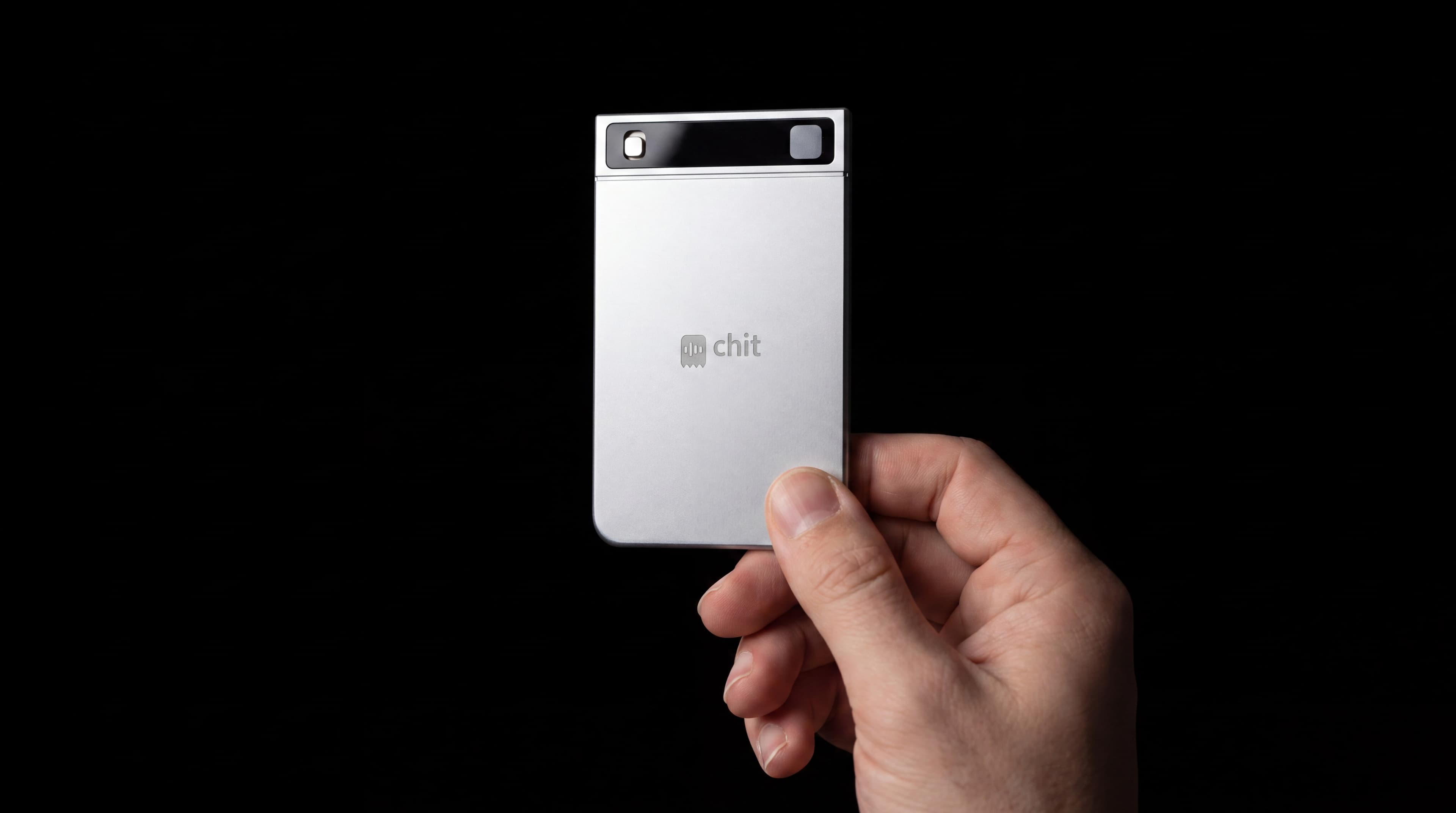
None of the above needs chit — it applies to a phone or any recorder. What a held card changes is that the good position is the natural one: you are holding it, so it is already near your mouth, rather than lying on a toolbox because you needed both hands.
chit records only while you hold the button, so on a loud site the recording starts when you have stepped away and ends when you are done, rather than capturing twenty minutes of compressor either side. It also records with no signal, which is the other constant of these environments.
We do not publish a noise-rejection specification, because we have not measured one and a number we cannot defend is worse than none. What we can tell you is what to do with it, which is what this page is.
Good questions
How close should I hold it?
Arm's length or nearer — about the distance you would hold something you were reading. Halving the distance helps more than anything you can do about the noise.
Will it filter out machinery?
We do not publish a noise-rejection figure because we have not measured one. The reliable technique is distance and turning your back to the source.
What ruins a recording fastest?
Wind, then distance. Wind saturates rather than competing, so a cupped hand outdoors is worth more than it looks.
Any trick for numbers?
Say them twice, once as a figure and once digit by digit, and say the units. It costs two seconds and it is usually the reason you made the note.
Reviewed 2026-08-07.
Nearby trades